

Floris Weegink
Field CTO
4 min read
12 October 2026
Vibe coding, low-code or custom: choosing the right tech for your app
The business has spoken: it needs an app, and you’re going to build it. Before you dive into development, though, you need to choose your technology. Broadly speaking, you have three options: vibe coding, low-code or custom development. Get that choice wrong, and you could end up with an application that falls over as more users log on at once. Or spend too much time and money on something you could have built with a straightforward low-code workflow.
That’s why we’ve put together a practical decision tree to help you choose the right approach and invest the right amount. In this blog, we’ll walk you through it so you can work out what fits your new application.
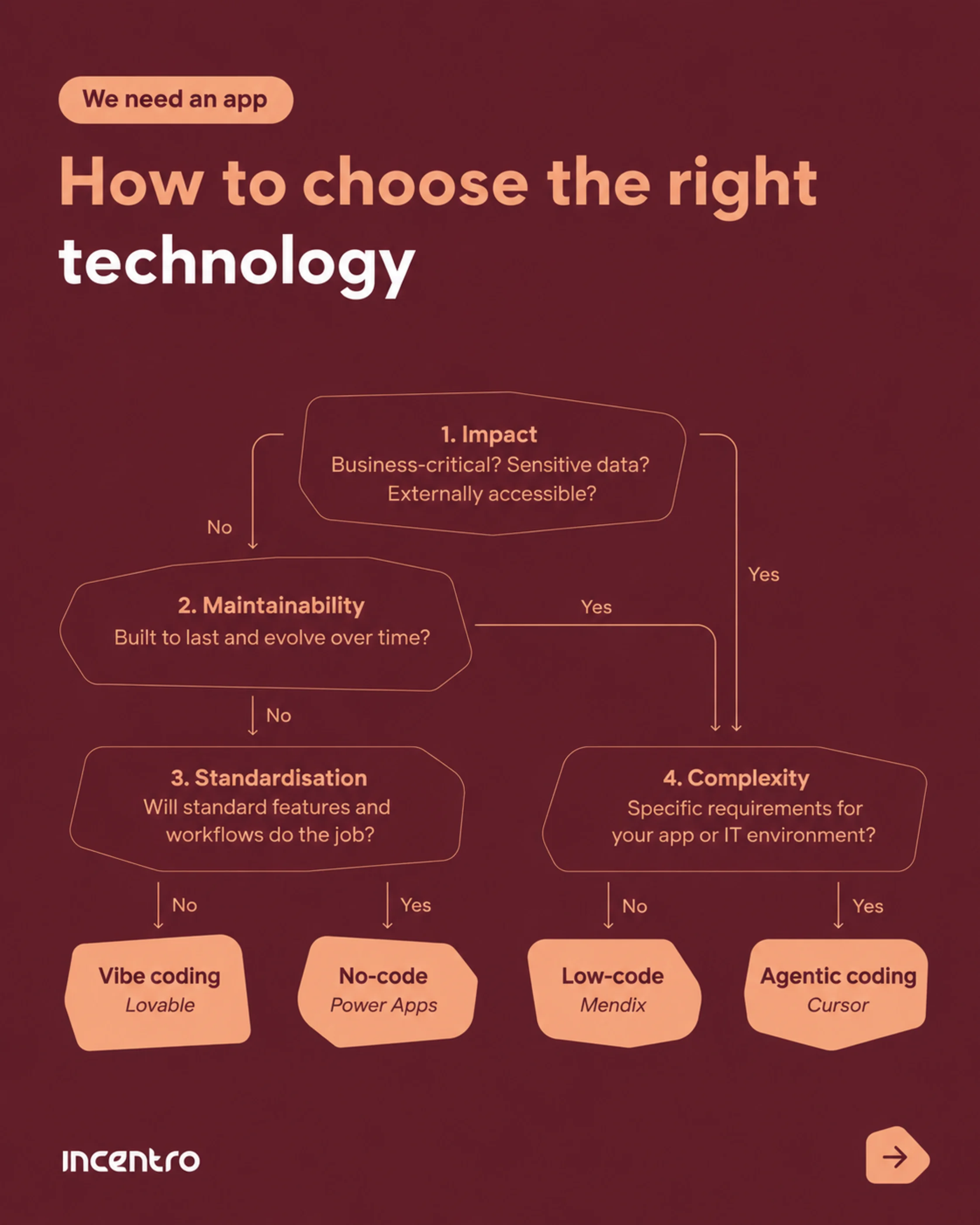
Question 1: What are the consequences if something goes wrong?
What happens if the app goes down, processes data incorrectly or leaks information? Is a small team briefly unable to work, or does a critical business process grind to a halt? Also consider what data the app handles and who can access it. Sensitive data and internet access raise additional security questions.
An internal app isn’t automatically a low-risk app. Even behind your firewall, an error can have serious consequences. If the stakes are high, you need an approach that takes security, testing and reliability seriously. Head to question 4 to assess whether low-code or custom development is the better fit.
Are the consequences limited, with no sensitive data involved and no external access? Move on to question 2.
Question 2: Required lifespan of the app?
A tool for a temporary task calls for a different approach from an application that needs to evolve over several years. Who will maintain it? Who will fix bugs? And can another developer take over later?
If the app needs to last, documentation, testing, updates and a smooth handover matter from day one. The initial build is only part of the bill. Maintenance, licensing and future changes all contribute to the total cost. In that case, head to question 4.
Is the app temporary, with limited use and little impact if something goes wrong? Vibe coding or a simple no-code solution could be a good fit. Question 3 will help you choose. Even for a temporary app, agree on who owns it and when it will be retired.
Question 3: Will standard features and workflows do the job?
You’re looking for a temporary solution with limited impact. Do you mainly need a form, an overview or a simple approval workflow? First, check whether you can build it using the components of a platform your organisation already uses. You don’t need to write new software for every problem.
Does your process fit those components without a string of workarounds? A no-code or low-code solution could be a practical choice. Just check the available integrations, access permissions and licensing.
Do you need more freedom over the interface or how the app works? Vibe coding can help you quickly build an internal prototype or temporary tool. Keep the scope small, review the generated code and test the app before others start using it.
Question 4: What specific requirements does your application or IT environment have?
Your application has a significant impact on the business and needs to last more than a year. That puts you in the territory of purpose-built applications, developed using a low-code platform or agentic coding. The choice depends on your requirements: integrations with existing systems, complex business rules, large numbers of concurrent users, or specific needs around performance, hosting and the user interface.
Can a platform like Mendix or OutSystems meet those requirements effectively? Then low-code is a strong candidate. It can handle complex business logic too, taking care of the underlying technical challenges so you can focus on business value.
Do you have your own engineers and a mature IT organisation with established software development standards? Then custom development is likely to be a better fit. Developers use agentic coding tools such as Cursor to dramatically speed up the work, putting teams of software development agents to work autonomously building software and deploying it to production.
At first glance, vibe coding and agentic coding may look similar because both use AI. But there’s a fundamental difference. Vibe coding is the toy that lets hobbyists turn ideas into working applications through written prompts. Agentic coding is the powerful tool reserved for senior engineers tackling complex development work. Think of it as an industrial-grade chainsaw: you need someone who knows what they’re doing to use it safely.
Conclusion
We've got your back
These questions give you a clearer picture of what your application needs. That helps you make an informed choice and explain to the business why it’s the right fit.
Want to talk through your plans? Book a meeting with Bob. Let's discuss the requirements, explore the options and work out what it takes to build your application properly.

Want to know more?
Bob Warnars
Commercial Lead
2 min read
Incentro becomes the first official LangChain partner in the Netherlands
5 min read
Youforce automates internal support with its own AI agent

2 min read
From a cloud solution to critical infrastructure in the logistics ecosystem

3 min read
Why legacy blocks your agility (and why you can't keep waiting)
